- By Our Correspondence
Civil society organisations in the Niger Delta have renewed calls for the immediate return of the 13 per cent derivation fund to oil-producing host communities, insisting that its continued control by state governments represents a distortion of the original intent and a betrayal of the historic struggle that gave birth to the policy.
The demand was made by the Niger Delta Civil Society Forum in a statement signed by its Coordinator, Comrade Ezekiel Kagbala, in Warri, Delta State. The group urged President Bola Ahmed Tinubu to honour the legacy of Chief (Dr.) Wellington O. Okirika, CON—a central figure in the derivation struggle—by correcting what it described as a long-standing injustice against oil-bearing communities.
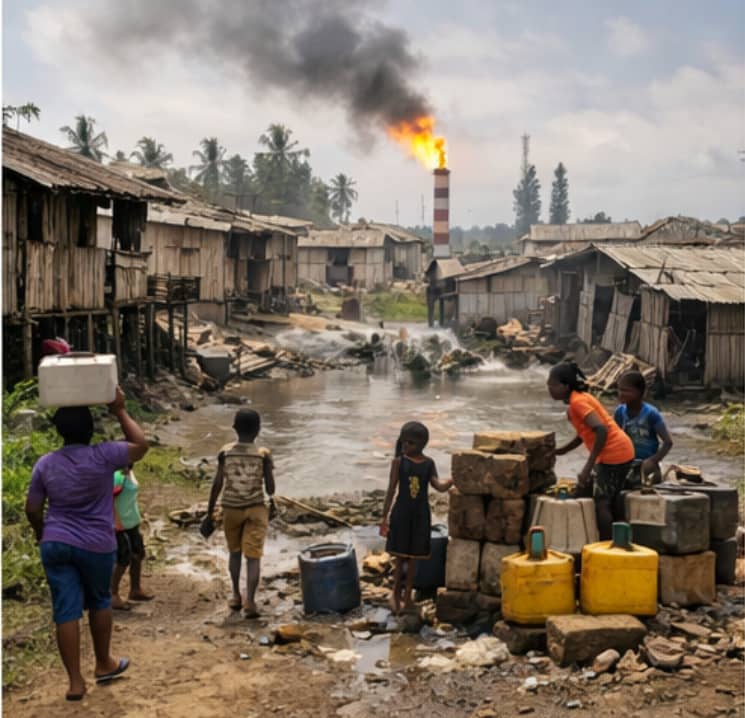
According to the Forum, oil-producing areas across Akwa Ibom, Bayelsa, Cross River, Delta, Edo, Ondo and Rivers States remain trapped in poverty despite generating the bulk of Nigeria’s revenue. It noted that polluted creeks, devastated mangroves, collapsing farmlands and declining fish stocks continue to define daily life in these communities, even as derivation revenues run into hundreds of billions of naira annually.
The group argued that governors, many of whom were not part of the original derivation struggle, now exercise near-total control over funds meant to compensate host communities for environmental degradation and loss of livelihoods.
“The 13 per cent derivation was never designed as a windfall for state governments,” Kagbala stated.
“It emerged from years of resistance, sacrifice and constitutional advocacy by host communities seeking justice for destroyed livelihoods and poisoned environments.”
While Section 162(2) of the 1999 Constitution (as amended) provides for the payment of not less than 13 per cent of revenue from natural resources to the states of derivation, the Forum maintained that equating the ‘state’ solely with state governments is a misinterpretation dating back to the Obasanjo administration.
The civil society body further warned that because oil and gas fall under the Exclusive Legislative List, the practice of routing derivation funds through governors has enabled massive resource capture, leaving host communities without basic infrastructure, quality education, healthcare facilities or meaningful environmental remediation.
For over a decade, the Chief Okirika—popularly known as “Mr. 13% Derivation Fund” consistently opposed this arrangement through the Host Communities of Nigeria Producing Oil and Gas (HOSTCOM), insisting that it undermined the spirit of the law and amounted to the hijack of host communities’ socioeconomic rights.
Traditional rulers, under the Association of Traditional Rulers of Oil Mineral Producing Communities of Nigeria (TROMPCON), have echoed similar concerns, repeatedly demanding that derivation funds translate into visible grassroots development such as roads, schools, healthcare facilities, shoreline protection and livelihood restoration.
Although intervention agencies like DESOPADEC in Delta State were created to address these gaps, the Forum noted persistent concerns over politicisation, limited reach and inadequate funding compared to the scale of environmental devastation in oil-bearing areas.
Citing official figures, the group disclosed that in the first half of 2025 alone, nine oil-producing states—Abia, Akwa Ibom, Anambra, Bayelsa, Delta, Edo, Imo, Ondo and Rivers—shared over ₦881 billion in derivation revenue. Despite this, many host communities still lack electricity, potable water and economic opportunities.
This, the Forum said, has intensified calls for the establishment of a Derivation Board and a Presidential Monitoring Committee to ensure transparency, accountability and direct community impact.
The group also called on President Tinubu, the National Assembly led by Senate President Godswill Akpabio, and the Revenue Mobilisation, Allocation and Fiscal Commission (RMAFC) to institute mechanisms that guarantee direct access of host communities to derivation funds.
The Pan Niger Delta Forum (PANDEF) has similarly aligned with the demand, with its spokesman, Chief Dr. Ominimini Obiuwevwin, repeatedly stressing that communities sustaining Nigeria’s economy deserve tangible development rather than perpetual neglect.
Attention was also drawn to chairmen of oil-producing communities, described as critical grassroots stakeholders whose silence, civil society groups warned, could amount to squandering a historic opportunity.
Reflecting on the roots of the struggle, Kagbala recalled that the derivation campaign peaked at the 1994–1995 Constitutional Conference, where Chief Okirika played a decisive role in raising derivation from three per cent to 13 per cent. His contributions, documented in his book, “Mr. 13% Derivation Fund: The Life and Legacy of Chief (Dr.) Wellington O. Okirika, CON,” were cited as evidence that progress is achieved through persistence and collective action.
The Niger Delta Civil Society Forum urged President Tinubu to remember the sacrifices behind the derivation principle and to act decisively, warning that reclaiming the 13 per cent derivation for host communities is “no longer optional but inevitable,” and that history will judge those who stood up and those who remained silent.