By Lucky Akoza
The Pan Niger Delta Forum (PANDEF) has renewed its call for justice, equity, and the proper implementation of the 13 per cent derivation fund, insisting that oil-producing communities must directly benefit from resources extracted from their land.
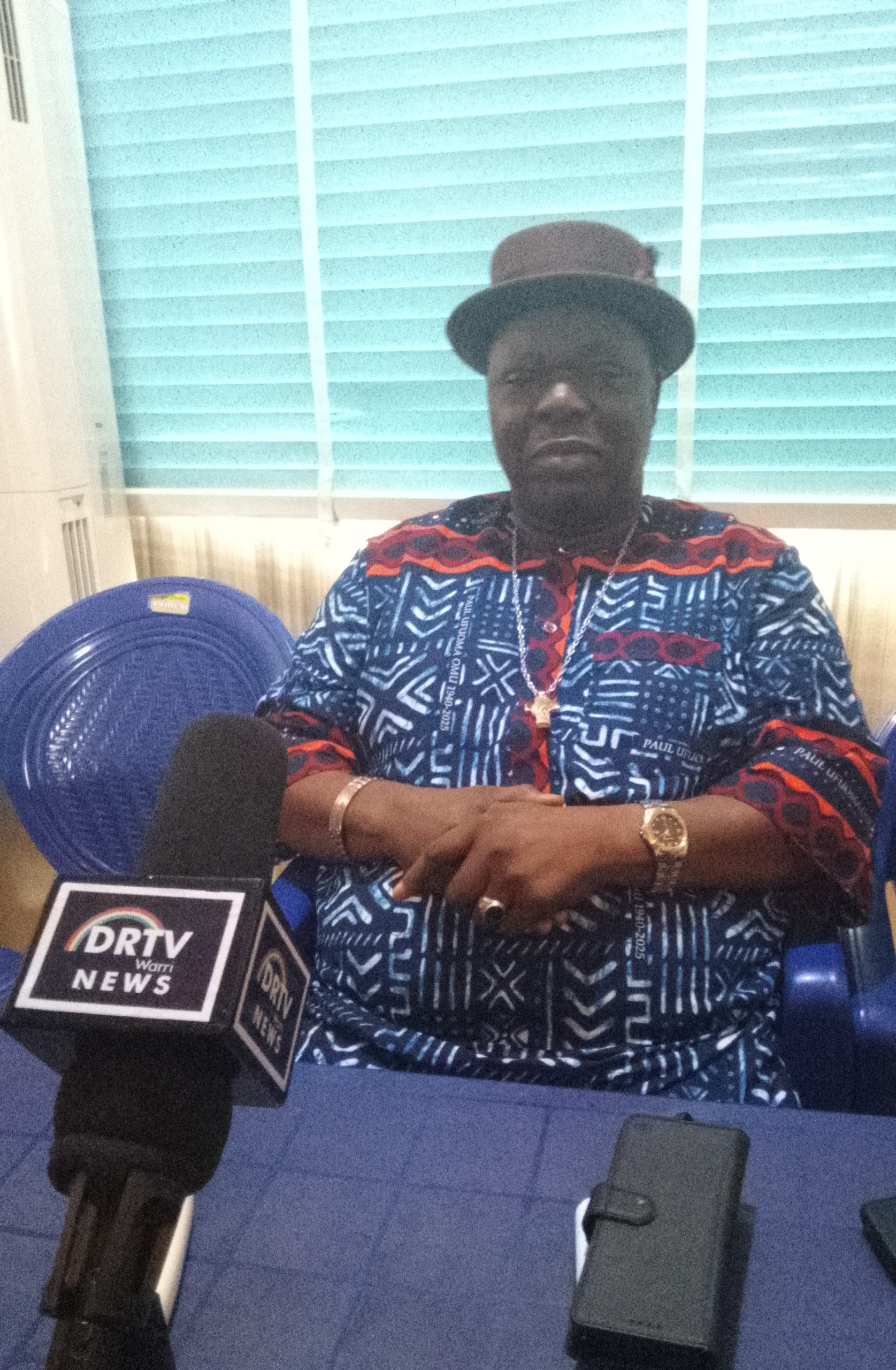
The PANDEF Spokesman, Chief (Sir) Ominimini Obiuwevbi, PhD, made the call during a media chat with members of the Nigeria Union of Journalists (NUJ), Ughelli Correspondents’ Chapel, at the NUJ Secretariat, Ughelli today Wednesday 04/02/26.
Chief Obiuwevbi declared that Nigeria is a very rich country blessed with abundant natural resources, particularly crude oil and gas, largely extracted from the Niger Delta.
“Anyone who says Nigeria is poor is not being truthful. This country survives mainly on oil and gas from the Niger Delta, yet the people from whose land these resources are taken are not benefiting as they should,” he said.
He noted that oil-bearing communities remain underdeveloped, impoverished, and environmentally degraded, despite producing intelligent and talented youths who are largely excluded from employment opportunities in the oil and gas sector.
“If you go to NNPC headquarters and its subsidiaries, you will hardly find Niger Delta people in strategic and decision-making positions. Even in human resources, our people are sidelined, and recruitments are often concluded before public announcements,” he alleged.
The PANDEF spokesman also condemned the neglect of federal ports in the Niger Delta, including Sapele, Koko, Warri, Burutu, Port Harcourt, Onne, and Calabar, describing their moribund state as politically motivated.
“While Lagos ports are overstretched, ports in the Niger Delta are abandoned. Their neglect is deliberate and must stop,” he said.
On energy infrastructure, Chief Obiuwevbi questioned why Nigeria continues to import refined petroleum products despite its crude oil wealth, noting that mini refineries and mini LNG plants are scarcely located in the Niger Delta. He urged the Federal Government to approve at least 30 mini refineries and LNG plants in the region, explaining that each plant could employ between 300 and 600 people, creating jobs and reducing restiveness.
He also criticised the Ajaokuta Kaduna, Kano (AKK) Gas Pipeline Project, saying the exclusion of the Niger Delta from its name was politically unacceptable.
On the 13 per cent derivation fund, Chief Obiuwevbi explained that although constitutionally guaranteed, its implementation has been distorted. He said routing funds solely through state governments was not originally intended to exclude host communities.
“A presidential fiat entrenched this practice, and today many governors treat derivation funds as general state revenue rather than special intervention funds for oil-bearing communities,” he stated.
Speaking further the former DESOPADEC Commissioner corrected historical misrepresentations about the Niger Delta Development Commission (NDDC). While the NDDC was established under former President Olusegun Obasanjo, it was the unity of Niger Delta Governors (1999–2007) and regional lawmakers that led to its creation, overriding presidential refusal.
He acknowledged that past NDDC administrations failed to deliver fully on their mandate but commended the current board led by Dr. Samuel Ogbuku for visibly implementing the NDDC Master Plan.
On environmental remediation, Chief Obiuwevbi described ongoing clean-up efforts, including Ogoni, as largely political rather than genuine. “Our rivers are dead, our farmlands poisoned, and communities that once farmed and fished now depend on imported frozen fish. This is a national shame,” he said.
He also decried double standards in law enforcement, noting that while artisanal refineries in the Niger Delta are militarised and destroyed, other illegal mining activities elsewhere face little scrutiny.
In conclusion, he stressed that PANDEF is not asking for special treatment but for justice, equity, and fairness.
“The Niger Delta is asking for Nigeria to be Nigeria for all Nigerians,” he said.